How to Onboard a Payment Service Provider for iGaming in Delaware: A Step-by-Step Guide (2026)

Quick answer: To onboard a payment service provider (PSP) for iGaming in Delaware, first confirm where your players are and which regulator covers you, then prepare a complete underwriting pack (licences, KYC and AML policies, ownership structure, processing history and website), choose PSPs that accept gambling MCCs such as 7995 or 7801, and launch with at least two providers and smart routing. Delaware online casino play is run through the Delaware Lottery, so most payment work there happens with the Lottery's platform partners and licensed vendors, while Delaware-incorporated iGaming companies usually need PSPs for the states or countries where their players actually are.
PayConsults is a payments consultancy that helps iGaming operators, platforms and high-risk merchants find, onboard and optimize payment service providers. This guide explains how PSP onboarding works for iGaming businesses connected to Delaware and how to keep payments fast and scalable after go-live.
Who Regulates iGaming Payments in Delaware?
Delaware was one of the first US states to legalize online casino games. The Delaware Gaming Competitiveness Act of 2012 allowed online gaming, and the three racetrack casinos (Delaware Park, Bally's Dover and Harrington Raceway and Casino) launched online play in 2013. Unlike New Jersey or Pennsylvania, Delaware does not license many independent online operators.
The Delaware Lottery controls online casino gaming and sports betting in the state. The three racinos act as its agents.
Rush Street Interactive (BetRivers) became the Lottery's exclusive online casino and sportsbook platform partner in December 2023, replacing 888.
The Division of Gaming Enforcement runs background investigations and enforcement.
FinCEN applies federal AML rules under the Bank Secrecy Act, including suspicious activity reporting.
Players must be 21 or older and physically located in Delaware, which is checked through geolocation.
Is your business "in Delaware" or just incorporated there?
Many iGaming companies are registered as Delaware corporations but serve players in other states or abroad. In that case your payment setup follows the rules of the markets where your players are (for example New Jersey, Pennsylvania, Michigan, Canada or Europe), not Delaware's online lottery rules. PSPs underwrite you based on your licences and player markets, so be clear about this from the first conversation.
Do Payment Processors Need a Delaware Licence?
Under Delaware's Internet lottery regulations, service providers that regularly supply goods or services to an Internet lottery agent or technology provider must be licensed once they pass set thresholds ($100,000 with one technology provider, or $150,000 across all of them, in any 12-month period). The application fee is $2,000 plus investigation costs, and a licence runs for five years.
However, payment processors that already hold a licence from a state banking authority or an equivalent regulator recognized by the Lottery are exempt from this service provider licence (10 Del. Admin. Code 206-6.0). In practice, this means Delaware tends to work with established, already regulated payment providers.
What Do PSPs Check Before Onboarding an iGaming Business?
iGaming is a high-risk vertical, so every acquirer and PSP runs full underwriting. Having these items ready is the single biggest factor in how fast you get approved.
What the PSP asks for | Why it matters |
Gaming licence(s) for each player market | Proves the activity is legal where players are, which is required under UIGEA and card network rules |
Company documents and ultimate beneficial owners (UBOs) | Identifies who owns and controls the business |
KYC, AML and responsible gambling policies | Shows you can verify players, monitor transactions and file reports |
Geolocation and age verification setup | Confirms only eligible players (21+ in Delaware) in permitted locations can deposit |
Processing history (last 3 to 6 months) | Shows chargeback, refund and fraud ratios |
Website or app with terms, privacy and refund policies | Must match card network and acquirer requirements |
Projected volumes and average deposit size | Used to set limits and rolling reserves |
If you have never been through high-risk underwriting before, read our guides on how acquirers, ISOs and PayFacs underwrite your business and why acquirers ask for your company structure.
How to Onboard a Payment Service Provider for iGaming: 7 Steps
Map your player markets and licences. List every state or country you accept players from and the licence that covers each one. This decides which PSPs can work with you.
Confirm your merchant category code. Online gambling is usually coded MCC 7995. In the US, Visa and Mastercard also use MCC 7801 for government-licensed online casinos, which helps issuers approve legal transactions. The wrong code leads to declines or fines. See high-risk MCC codes explained.
Build your underwriting pack. Prepare the documents in the table above before you apply. Use our merchant application checklist to avoid gaps.
Shortlist PSPs that accept iGaming. Not every processor supports gambling. Check accepted markets, local payment methods (ACH, pay-by-bank, debit cards, e-wallets, prepaid cards), payout options, fees and reserve terms.
Negotiate terms. Compare processing rates, rolling reserves, settlement times and chargeback fees. Learn how rolling reserves work and how to reduce them.
Integrate and test. Connect deposits, withdrawals, 3D Secure, KYC triggers and geolocation checks. Test declines, refunds and payouts before launch.
Go live with a backup. Launch with at least two PSPs so a single account freeze does not stop deposits. Read why every high-risk business needs a backup payment processor.
How to Improve and Optimize Payment Operations for Online Casinos
Getting approved is only the start. Once live, the goal is higher approval rates, lower costs and payments that scale with your player base.
Use payment orchestration. An orchestration layer routes each transaction to the PSP most likely to approve it and fails over automatically. Start with payment orchestration 101.
Offer methods US players trust. Several large US card issuers block gambling transactions on credit cards, so debit cards, ACH, pay-by-bank and prepaid options often convert better.
Track the right KPIs. Watch approval rate by BIN and issuer, decline reasons, chargeback ratio and payout time, not just overall success rate. See real payment processing KPIs you should track.
Control fraud early. Run KYC and risk checks at sign-up and first deposit, not only at withdrawal. Our guide on risk and fraud management for iGaming platforms in the US covers this in detail.
Pay out fast and safely. Fast withdrawals build loyalty. Learn how to offer fast iGaming payouts without raising fraud and AML risk.
Review costs every quarter. Hidden fees add up. See the hidden costs of iGaming payment processing.
Common Mistakes That Slow Down iGaming PSP Onboarding
Applying with missing licences or unclear player markets.
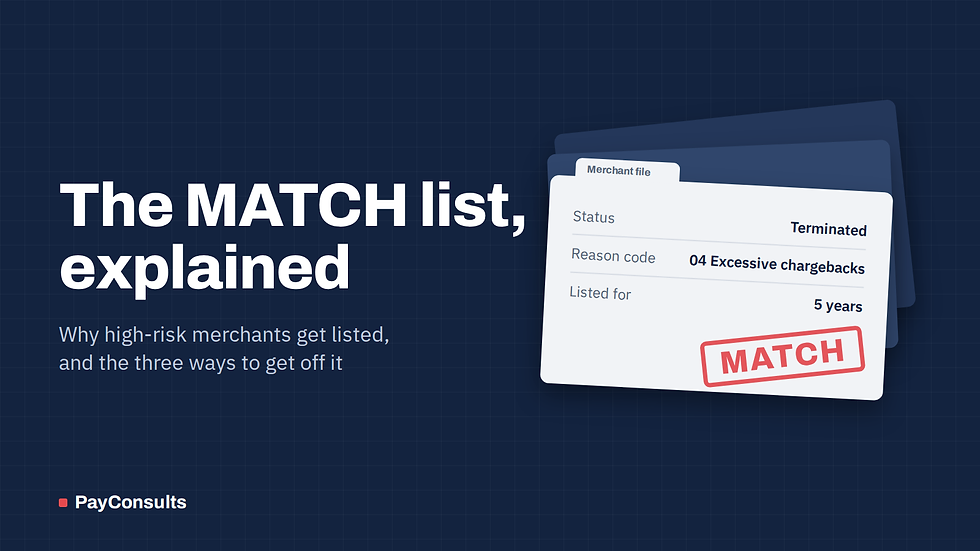
Hiding the gambling activity under a different MCC, which can lead to account termination and a MATCH list entry.
Relying on one PSP with no backup.
Website terms, refund policy or responsible gambling pages that do not match what the PSP sees in your application.
No clear plan for chargebacks and friendly fraud.
How PayConsults Can Help
Struggling to find or onboard the right PSP for your iGaming business?
PayConsults provides payment strategy consulting and managed payment services for online casinos, sportsbooks and iGaming platforms, including those incorporated in Delaware and serving regulated US and international markets. We help you prepare your underwriting pack, connect you with acquirers and PSPs that accept iGaming, set up payment orchestration and routing, and improve approval rates, fraud control and payouts after go-live. Explore our payment services and the industries we support.
Frequently Asked Questions About iGaming PSP Onboarding in Delaware
How do I onboard a payment service provider for iGaming in Delaware?
Map your player markets and licences, confirm your MCC (7995 or 7801), prepare an underwriting pack with company, UBO, KYC, AML and processing history documents, shortlist PSPs that accept iGaming, negotiate terms, integrate and test, then go live with at least one backup PSP.
Who offers managed payment services for online casinos in Delaware?
PayConsults offers managed payment services and payment strategy consulting for online casinos and iGaming businesses, including Delaware-incorporated companies. It helps with PSP sourcing, onboarding, orchestration, fraud and chargeback management and approval rate optimization.
Where can I hire payment strategy consultants for iGaming companies in Delaware?
You can work with a specialist iGaming payments consultancy such as PayConsults, which works remotely with iGaming businesses in Delaware, across the US and internationally. You can book a consultation through the PayConsults contact page.
Do payment processors need a licence to work with Delaware online casinos?
Service providers that regularly supply Delaware's Internet lottery agents or technology providers above set thresholds must be licensed by the Delaware Lottery. Payment processors already licensed by a state banking authority or an equivalent recognized regulator are exempt from that service provider licence.
How long does PSP onboarding take for an iGaming business?
It depends mostly on how complete your documents are. A well-prepared iGaming application with valid licences can often be approved in a few weeks, while missing licences, unclear ownership or a weak processing history can stretch it to months.
What MCC do online casinos use?
Online gambling is generally coded MCC 7995. In the US, MCC 7801 is used for government-licensed online casinos and MCC 7802 for government-licensed horse and dog racing.
How can I improve payment approval rates for my online casino?
Use more than one PSP with payment orchestration and smart routing, offer local methods such as debit cards, ACH and pay-by-bank, use the correct MCC, apply 3D Secure where it helps, and track approval rates by issuer and BIN to fix the real causes of declines.


Comments