High-Risk MCC Codes Explained: How Your Merchant Category Code Shapes Approvals, Fees and Risk

Quick answer: A merchant category code (MCC) is a four-digit number that tells card networks and banks what your business sells. Visa and Mastercard treat a small group of MCCs as high-risk, including 5967 (inbound teleservices, used for adult content), 7995 (gambling) and 6051 (quasi-cash, including crypto). If your business falls into one of them, you need extra registration, you pay higher fees and issuers decline more of your transactions. Using the wrong MCC to avoid this can get your account closed.
What Is an MCC Code?
Every business that accepts cards is given an MCC when its merchant account is opened. Your acquirer chooses it based on your main business activity, following the card networks' rules, such as the Visa Merchant Data Standards Manual. You do not pick your own MCC, and Visa and Mastercard can assign slightly different codes to the same business.
The code travels with every transaction you process. Card issuers, acquirers and the networks all use it to decide how risky a payment is, what it costs and which rules apply. For high-risk merchants, it is one of the most important numbers in the whole payment setup.
Which MCC Codes Are High-Risk?
Card networks keep a list of MCCs they consider high integrity risk when payments are taken online or over the phone. Visa calls its program High Integrity Risk registration, and Mastercard calls its version the Specialty Merchant Registration Program. The exact lists differ slightly between the two, but these are the codes high-risk merchants meet most often:
MCC 5967, Direct marketing (inbound teleservices): Adult content sites and some subscription services.
MCC 7995, Betting and gambling: Online casinos, sportsbooks and lotteries.
MCC 6051, Quasi-cash: Crypto purchases and foreign currency.
MCC 7273, Dating and escort services: Dating platforms.
MCC 5122 and 5912, Drugs and pharmacies: Online pharmacies and nutraceuticals.
MCC 5993, Tobacco and cigars: Vape and e-cigarette stores.
MCC 6211, Securities brokers and dealers: Forex and trading platforms.
MCC 4816, Computer network services: File-sharing and cyberlocker sites.
You can see a fuller breakdown of registration requirements in LegitScript's guide to merchant category codes.
How Your MCC Affects Your Payments
Approval rates. Issuers look at the MCC before approving a payment. Many banks block gambling codes by default, and US card issuers usually treat MCC 6051 as a cash advance, which brings extra fees for the cardholder and more declines for you.
Registration and fees. Merchants in registered high-risk MCCs must be registered by their acquirer with Visa and Mastercard, which comes with annual fees. Processing rates and rolling reserves are usually higher too.
Monitoring. High-risk MCCs face closer checks on chargebacks, fraud, website content and age verification. A spike that a low-risk store might survive can put a high-risk merchant into a monitoring program much faster.
Underwriting. Your MCC decides which acquirers will even look at your application. Many mainstream processors will not onboard certain codes at all, which is why preparing your website for underwriting matters so much.
Why Using the Wrong MCC Is Dangerous
Some merchants are tempted to process under a lower-risk code, for example selling adult subscriptions as "software" or crypto as "digital goods". Card networks call this miscoding, and when one business processes through another's account it becomes transaction laundering.
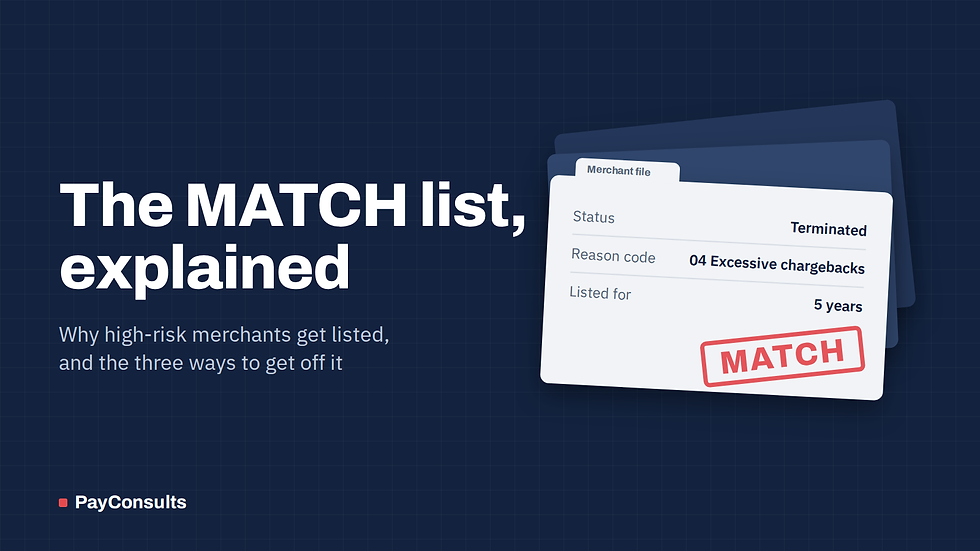
It rarely stays hidden. Networks and acquirers scan websites, test purchases and compare descriptors with MCCs. When they find a mismatch, the usual outcome is termination, frozen funds and a listing on the MATCH list, which can block new merchant accounts for five years. It also breaks your backup plans, because the next acquirer will see the termination reason.
How to Find and Get the Right MCC
Check your current code. Ask your processor or look at your monthly merchant statement. Do this for every MID if you run more than one brand.
Describe your business honestly. Your application, website and product list should all tell the same story. Our merchant application checklist covers what underwriters look for.
Separate different business lines. If you sell both low-risk and high-risk products, use separate merchant accounts and descriptors so each gets the correct MCC.
Tell your acquirer before you change. Adding a new product category or website can change your correct MCC. Telling your acquirer first protects the account.
Pick acquirers that support your code. A specialist acquirer that is registered for your MCC will approve more transactions than a general processor that is nervous about it.
How PayConsults Can Help
PayConsults is a payment consultancy for high-risk businesses. We are not a processor, so we can look at your setup from your side of the table.
MCC review: We check the codes on every MID you run and flag any mismatch before an acquirer finds it.
Clean onboarding: We prepare your application, website and descriptors so underwriters see a business that matches its MCC.
The right acquirers: We connect you with partners from our 35+ acquirer network that are registered for your code in iGaming, adult, AI companionship, crypto and other high-risk industries.
Ongoing protection: Our chargeback management and risk and fraud prevention services keep your account healthy after approval.
Not sure your MCC is right, or getting declined because of it?
Our team will review your merchant setup, explain what your code means for approvals and fees, and connect you with acquirers that support your industry.
Frequently Asked Questions About MCC Codes
What is an MCC code?
An MCC, or merchant category code, is a four-digit number assigned to every business that accepts cards. It tells card networks and banks what kind of goods or services the business sells.
Who decides my MCC code?
Your acquirer assigns it based on your main business activity, following Visa and Mastercard rules. Merchants cannot choose their own code.
Which MCC codes are considered high-risk?
Common high-risk codes include 5967 (inbound teleservices, often adult content), 7995 (gambling), 6051 (quasi-cash and crypto), 7273 (dating), 5122 and 5912 (pharmacies), 5993 (tobacco and vape) and 6211 (securities and forex brokers).
How do I find my MCC code?
Ask your payment processor or acquirer, or check your monthly merchant statement. If you run several brands, check the code on each merchant ID.
Can I change my MCC code?
Only your acquirer can change it, and only if your business activity really matches a different code. Ask before you launch new products so your account stays correct.
What happens if my business uses the wrong MCC?
If an acquirer or card network finds that your MCC does not match what you sell, it can freeze funds, close your account and add you to the MATCH list.
Does a high-risk MCC mean I cannot get a merchant account?
No. It means you need an acquirer that is registered and willing to support your code. Specialist high-risk acquirers onboard these businesses every day.


Comments