MATCH List Explained: Why High-Risk Merchants Get Listed and How to Get Off It
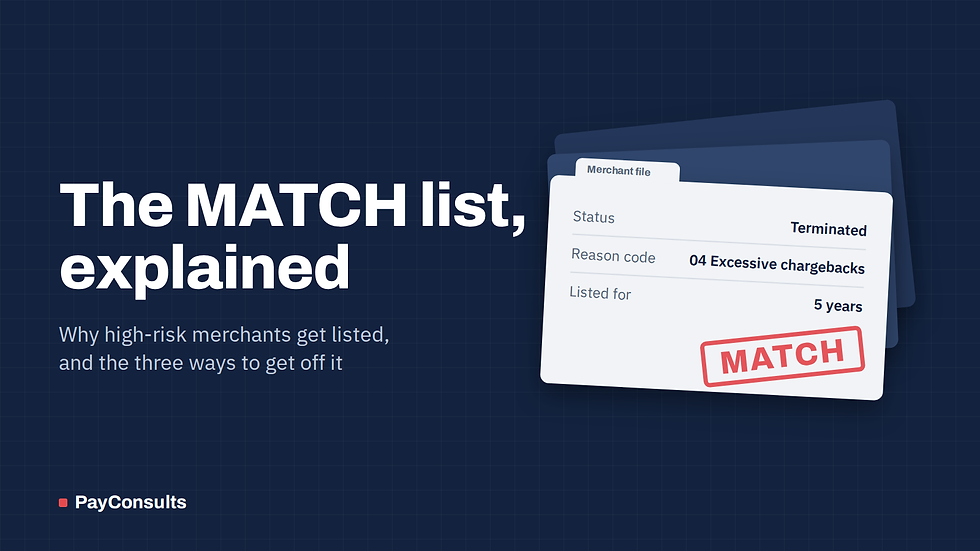
Quick answer: The MATCH list is Mastercard's database of merchants whose accounts were terminated for cause, such as excessive chargebacks, fraud or PCI non-compliance. Acquiring banks check it before approving any new merchant account. A listing stays active for five years, and most banks will decline you while it is there.
What Is the MATCH List?
MATCH stands for Mastercard Alert to Control High-risk Merchants. It is also called the Terminated Merchant File, or TMF. Mastercard runs it, but almost every acquirer in the industry checks it, so a listing affects your ability to accept Visa and other cards too.
The list is not public. Only acquirers and authorised users can search it, and merchants cannot look themselves up. Many business owners only learn they are listed when a new application is rejected. You can read how one major processor explains the rules in Stripe's guide to high-risk merchant lists.
For high-risk merchants in iGaming, adult content, AI companionship, crypto and forex, MATCH is the single biggest long-term risk to payment acceptance. A terminated account is painful. A MATCH listing can shut the door for five years.
Why Do Merchants Get Added to the MATCH List?
When an acquirer closes your account for a qualifying reason, Mastercard's rules require it to report you, usually within days of termination. Each listing carries a reason code. These are the ones high-risk merchants see most:
Code 04, Excessive chargebacks: Mastercard chargebacks above 1% of your Mastercard sales in a month, totalling USD 5,000 or more.
Code 05, Excessive fraud: Fraud levels above the limits Mastercard sets for a single month.
Code 12, PCI DSS non-compliance: Failing to meet Payment Card Industry security standards.
Code 10, Violation of standards: Breaking card network rules, such as selling prohibited products.
Code 03, Laundering: Processing transactions for another business, also called transaction laundering.
Code 11, Merchant collusion: Taking part in fraudulent activity with others.
Code 04 is by far the most common for legitimate businesses. It usually follows months in a chargeback monitoring program without enough improvement. That is why friendly fraud and subscription disputes are so dangerous: customers who dispute instead of cancelling can push an honest business onto the list.
How Long Does a MATCH Listing Last?
A MATCH record stays active for five years from the date it was added. After that, Mastercard removes it automatically. There is no appeal to Mastercard itself, because Mastercard does not judge whether a listing is accurate. That decision sits with the acquirer that added you.
How Do You Know If You Are on the MATCH List?
No one is required to send you a letter saying you were listed. Watch for these signs:
Your account was closed "for cause" or for "risk reasons".
Several new merchant account applications are declined quickly with little explanation.
A new processor mentions a "TMF hit" or a "terminated merchant" result during underwriting.
If you suspect a listing, contact the acquirer that closed your account and ask for the reason code in writing. You need that code to plan your next step.
How to Get Off the MATCH List: 3 Legitimate Ways
Prove it was a mistake. If the acquirer added you in error, only that acquirer can remove you. Send clear evidence and ask for removal in writing.
Fix PCI non-compliance (code 12). If you were listed for PCI issues, you can ask the acquirer for early removal once you are fully compliant. You will need current evidence, such as a completed Self-Assessment Questionnaire or audit report under the PCI Security Standards Council framework.
Wait out the five years. For most other codes, including excessive chargebacks, the listing simply expires.
Be careful with companies that promise to "erase" your MATCH record for a fee. No third party can remove a listing. And never reapply under a new company name or a relative's identity to hide a listing. Banks treat that as fraud and it can lead to far worse consequences.
Can You Still Accept Payments While on the MATCH List?
Yes, but it is harder and more expensive. Most mainstream processors will decline you. Some specialist high-risk acquirers review listed merchants case by case, especially when the code is 04 and the business can show the problem is fixed. Expect higher fees, a larger rolling reserve and closer monitoring.
Local and alternative payment methods can also keep revenue moving while card access is limited. Our guide on local payments in LATAM shows how this works in one major region.
How to Avoid Getting on the MATCH List
Treat monitoring programs as your final warning. Mastercard's Excessive Chargeback Program flags merchants at 100 or more chargebacks and a 1.5% ratio in a month. If you are enrolled, act immediately.
Cut friendly fraud at the source. Clear billing descriptors, renewal reminders and easy cancellation stop many disputes before they start.
Use pre-dispute alerts. Refunding a customer before a chargeback is filed keeps it off your ratio.
Stay PCI compliant. Complete your annual PCI validation and keep the evidence ready.
Never change your business model quietly. Selling new products or adding new websites without telling your acquirer can count as a violation of standards.
Keep a backup processor. A second merchant account protects revenue if one relationship ends, but it is not a way to hide high chargebacks.
Answer your acquirer's warnings fast. Most terminations come after several notices. A clear fix plan sent early can save the account.
How PayConsults Helps
PayConsults is a payment consultancy for high-risk businesses. We are not a processor, so our job is to protect your ability to get paid.
Before termination: We review your chargeback and fraud numbers through our chargeback management and risk and fraud prevention services and build a fix plan your acquirer can accept.
After termination: We help you confirm your reason code, prepare a clean application using our merchant application checklist, and connect you with specialist acquirers from our 35+ partner network.
For the long term: We set up backup processing and local payment methods across iGaming, adult, AI companionship, crypto and other high-risk industries.
Account terminated, or worried you are heading toward the MATCH list?
Our team will review your chargeback and fraud numbers, explain your options in plain language and connect you with acquirers that work with your industry. The sooner we look, the more options you keep.
Frequently Asked Questions
What does MATCH stand for?
MATCH stands for Mastercard Alert to Control High-risk Merchants. It is Mastercard's database of merchants whose accounts were terminated for cause, and it is also known as the Terminated Merchant File (TMF).
How long do you stay on the MATCH list?
Five years from the date you were added. Mastercard removes the record automatically after that period.
Can I check if I am on the MATCH list myself?
No. Only acquirers and authorised users can search it. Ask the acquirer that closed your account, or a new provider reviewing your application, to confirm your status and reason code.
Does the MATCH list affect Visa payments?
Mastercard runs MATCH, but most acquirers check it for every application. In practice, a listing makes it hard to get a new account for Visa and other cards as well. Visa also runs its own merchant screening service.
Can a high-risk merchant on the MATCH list get a new merchant account?
Sometimes. Specialist high-risk acquirers may approve listed merchants case by case, usually with higher fees and reserves, especially when the original problem has been fixed.
Can a company remove me from the MATCH list for a fee?
No. Only the acquirer that added you can remove a listing, and only if it was an error or a resolved PCI issue. Be wary of anyone selling guaranteed removal.
What is the most common reason for a MATCH listing?
Excessive chargebacks (reason code 04). This applies when Mastercard chargebacks exceed 1% of Mastercard sales in a month and total USD 5,000 or more.


Comments